How to choose your paraglider: Level, Practice, and Weight Range (PTV)

Choosing a paraglider can be a complicated process, as the selection criteria are so vast. To help you make your choice, this article gives you a few important points to consider.
Are you looking for a specific model?
Firstly, there's the style of flying. Whether you're aiming for site flying, walk & fly or acrobatics, there will always be paraglider models more or less well suited to every type of paragliding.
Secondly, your level of paragliding is also an important factor. It's precisely your level and your expectations that will guide you towards the most suitable category of paraglider. Finally, your weight is important, as it will be taken into account in addition to the weight of the equipment you're interested in, giving you your TWA, “total flying weight”.
CHOOSING THE RIGHT PARAGLIDER FOR YOU
If you're new to paragliding, it's a good idea to consider the certification of your future wing. There are a number of different approvals available to classify paragliders.
BEGIN PARAGLIDING WITH AN EN A PARAGLIDER
For beginners to free flight and paragliding, it's essential to choose a glider suited to your skill level. EN A gliders are specially designed for novice pilots, offering increased stability and ease of piloting. These gliders have a moderate glide ratio and smooth flight characteristics, making them perfect for learning the basics of paragliding in complete safety.
In addition, EN A gliders offer a high tolerance of pilot error, allowing beginners to gradually familiarize themselves with the control of their glider. These gliders generally react slowly to the controls, avoiding sudden movements and unforeseen situations that could be difficult for a beginner pilot to handle.
PROGRESSING TO PARAGLIDING WITH AN EN B GLIDER
Once pilots have gained sufficient experience and confidence in flight, they can switch to an EN B paraglider. These gliders offer a good balance between stability and performance, making them ideal for intermediate pilots looking to continue progressing in their flying.
EN B gliders generally have better glide and speed than EN A gliders, enabling pilots to achieve more ambitious cross-country flights and fly in a wider range of weather conditions. However, they also require a certain mastery of piloting skills, as they can react more quickly to commands than EN A gliders.
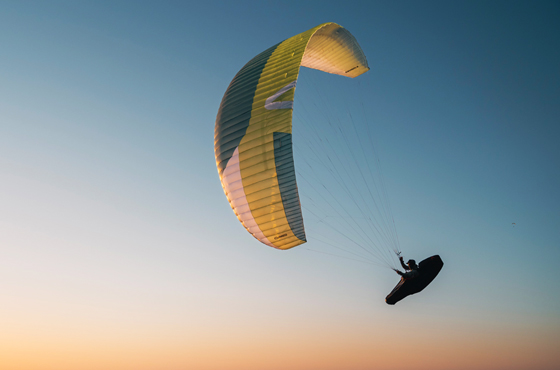
PERFORM IN PARAGLIDING WITH EN C/D and CCC GLIDERS
For experienced pilots looking for performance of a certain caliber, EN C, D and CCC gliders are the ideal choice.
These gliders are designed to offer enhanced handling and responsiveness, making them suitable for advanced pilots looking to push their limits in flight.EN C category gliders offer an optimum combination of performance and stability, making them popular with cross-country pilots looking for long-distance flights. However, their passive safety remains relatively attractive. This makes for a healthier wing behavior than D or CCC gliders.
EN D-approved wings are even more efficient than C-rated wings. However, we are starting to see wings that require very good pilots under the wing, as performance is the main criterion for these wings. This implies better glide ratio, and compared to EN C wings, better accelerated glide ratio. As a result, pilots are bound to fly at high speeds and low angles of incidence. In the event of a flight incident, the wing's reactions will be sharper, and the pilot will need to know how to manage his bulk. These are the kind of wings we typically see in competition and on very long-distance flights, as they enable us to fly fast and far.
CCC paragliders are designed for expert pilots who practice paragliding and competition at a high level. They are designed to be extremely powerful and responsive, but they also require a high level of piloting skill to be used to their full potential in complete safety.
CHOOSING THE RIGHT PARAGLIDER FOR YOUR TYPE OF FLIGHT
As you probably know, there are several paragliding disciplines. Here is a short, non-exhaustive list of the main disciplines and their associated wing types :
-
Site flying : there's really no such thing as a “site” wing , because anyone with any type of glider can take off, fly and land at their preferred flying site.
-
Hike and Fly or Rando Flying : For this type of flying, the choice of glider will vary widely, as pilots may have several objectives in mind. Whether it's for pure rando flying, or a hike followed by a distance flight, you'll find all types of wings (A,B,C,D) available in light or ultra-light versions to suit each objective.
. -
Long-distance flying : Nowadays, it's perfectly possible to make long-distance flights even with beginner EN A wings . However, more experienced paragliders tend to prefer more technical wings that allow longer flights. These wings are more powerful and fly faster. This enables the pilot to fly longer, faster routes. Thinner and easily recognizable by their elongation, paraglider wings designed for long-distance flights will also require active piloting.
-
Acrobatic : For this practice, pilots should opt for small surface wings made to favor a high load factor to make the wing dynamic. These wings are generally only tested under load, and require an advanced level of piloting. Thrills guaranteed!
-
Soaring : Soaring can be done with any type of wing ! However, in areas where the wind can be very strong, mini-paraglider are much better suited to maintaining good airspeed.
-
Speed-riding: Speed riding is a thrilling discipline that combines paragliding with skiing for fast, dynamic flights over snowy slopes.

CHOOSING YOUR PARAGLIDER ACCORDING TO ITS TWA
As mentioned earlier in this article, the TWA (total weight in flight) is defined by the sum of all the equipment plus the pilot's weight. To get a good estimate of TWA, we generally add the weight of the wing, harness and reserve parachute to that of the pilot. To this total, we add 2 or 3 kg of clothing, shoes and water bottle that can be carried. This gives you a good estimate of your total weight.
Once you've estimated your total weight, you'll be able to identify the appropriate wing size. We can define 3 flight ranges on a wing :
-
Flying at the bottom of the range : This protects your wing, as it is subjected to less stress. Take-off and landing speeds are lower. As a result, you'll generally need to run less, which makes phases close to the ground more comfortable. In flight, you'll have a lower maximum speed, the brake controls will feel a little sluggish and the wing will be less responsive to turns. However, your sink rate will be lower, which will be an advantage in thermals.
-
Flying in the middle of the range : Generally speaking, this is the setting most recommended by the manufacturers, to obtain the best ratio of flight comfort to wing performance. If you have the possibility, fly in the middle / middle-high range.
-
Flying at the top of the fork : Flying at the top of the fork gives the wing better penetration and speed. This is particularly noticeable upwind. The wing is less sensitive to collapses, but when they do occur, they can be more pronounced. Take-off and landing phases are carried out at greater speed. Finally, one of the advantages of flying at the top of the range is that the feel at the controls is generally more pleasant and precise. The wing gains in responsiveness.
 English
 Français
 Deutsch