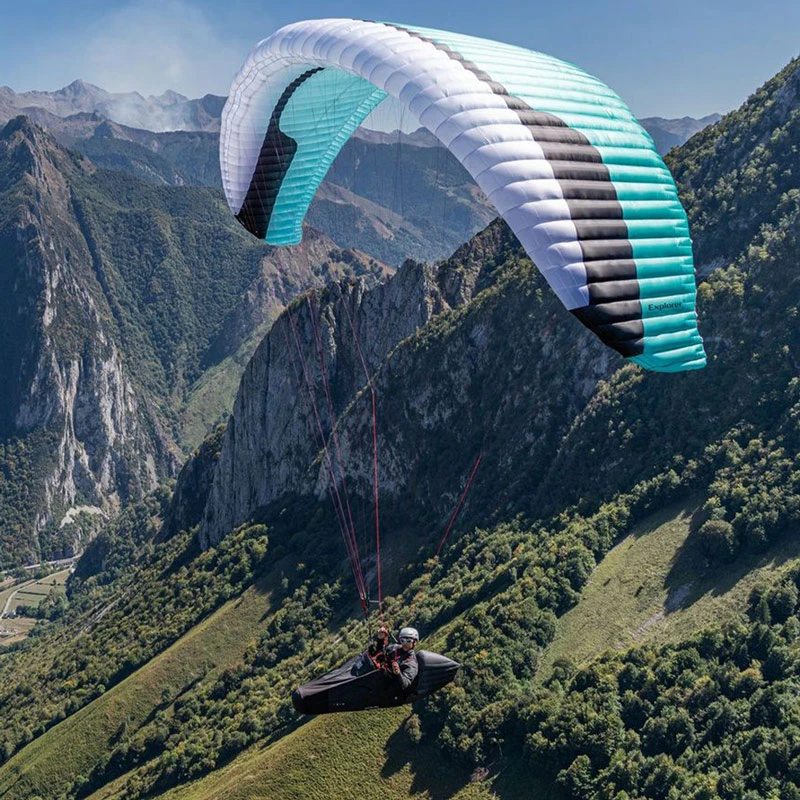
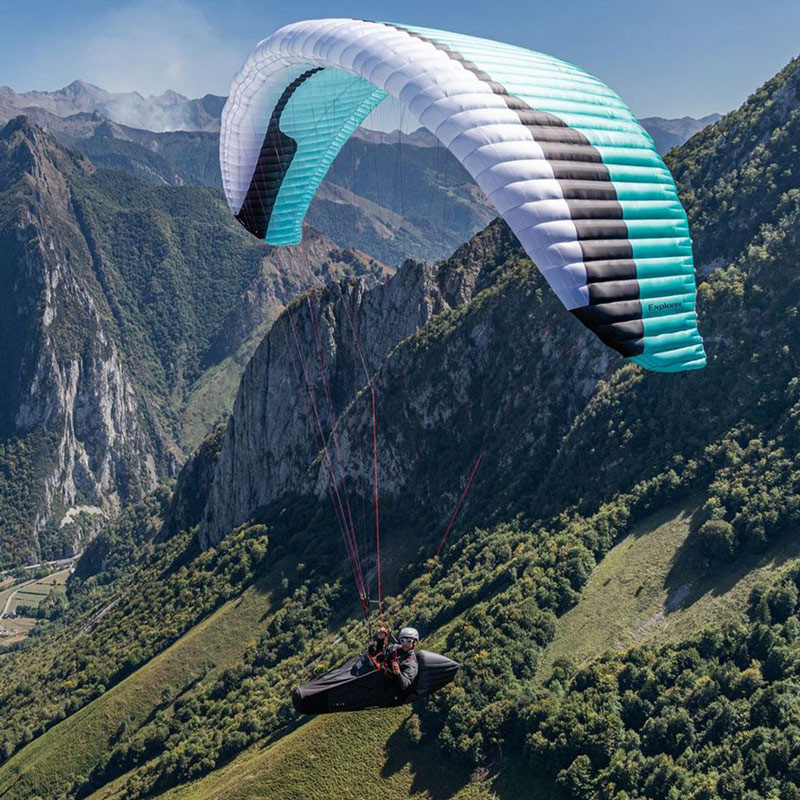
GIN Explorer 3: an EN-B built for cross-country flying
With the Explorer 3, GIN takes its EN-B wing designed for cross-country flying to a new level. This third generation goes far beyond a few minor adjustments: the airfoil, planform, internal structure, wingtips and line layout have all been redesigned to create a faster, more efficient wing with excellent performance on long glides.
The objective remains true to the spirit of the Explorer range: to offer a wing capable of covering serious distances without demanding the level of commitment associated with a higher category. The Explorer 3 therefore combines performance, stability and flying comfort, with accessible handling for a wing of this level.
A new airfoil for greater stability
One of the main developments of the GIN Explorer 3 is its new airfoil. It has been designed to provide greater natural pitch stability. In turbulent or irregular air, the wing tends to maintain its attitude more effectively, requiring fewer constant corrections from the pilot.
This stability provides a solid and consistent platform from which to make the most of the wing’s performance. In active conditions, the Explorer 3 remains communicative without becoming unnecessarily demanding, allowing the pilot to focus more on choosing the best line, finding lift and planning the next stage of the flight.
More glide and efficiency on transition
To improve overall efficiency, GIN has worked extensively on the shape of the wingtips. The new elliptical stabilos combined with raked wingtips help manage wingtip vortices more effectively and reduce induced drag.
These improvements become particularly noticeable as speed increases. On long transitions, the Explorer 3 offers excellent glide performance and high efficiency when accelerated, two essential qualities for pilots looking to cover more kilometres on cross-country flights.
Wave Leading Edge: an optimized leading edge
The Explorer 3 also benefits from GIN’s Wave Leading Edge technology. Inspired by the tubercles found on humpback whale flippers and developed through the GIN LAB programme, this distinctive leading-edge design aims to improve the wing’s aerodynamic behaviour at high angles of attack.
In practice, this technology helps reduce the sink rate at low speed, makes the behaviour approaching the stall more progressive and improves pitch stability. It also contributes to greater cohesion across the entire span of the wing, an advantage when efficiently working thermals and flying through turbulent air.
Precise handling for efficient thermalling
Handling has always played an important role in the Explorer range. On this third generation, GIN has increased the brake travel and improved energy management throughout the turn.
The Explorer 3 can therefore be precisely controlled according to the conditions: relatively flat turns for efficiently working broad areas of lift, or steeper bank angles when staying centred in a narrow thermal core. The wing retains its energy through the turn while giving the pilot precise control over the bank angle. It also maintains the strong low-speed capabilities already found on the Explorer 2.
C-riser steering designed for long transitions
For cross-country flying, a high-performance wing must also remain easy to control while accelerated. The Explorer 3 therefore features a rear-riser steering system, allowing precise heading and pitch corrections without coming off the speed bar.
This allows the pilot to manage changes in the air mass more effectively while maintaining speed and glide performance. The geometry of the system has been optimized to provide clear feedback and comfortable control forces, particularly useful during long cross-country transitions.
A lightweight and technical construction
At just 3.75 kg in size M, the Explorer 3 retains a lightweight construction that is particularly appealing to pilots who travel, regularly hike with their equipment or simply want to keep the overall weight of their gear to a minimum.
Its construction features a 3-line architecture, Nitinol rods and unsheathed aramid lines. The Dominico Dokdo fabrics used for the upper and lower surfaces also contribute to the balance between low weight, performance and build quality.
Who is the GIN Explorer 3 for?
The GIN Explorer 3 is primarily aimed at experienced EN-B pilots who want to develop their cross-country flying and are looking for a wing capable of accompanying them on increasingly long flights.
It is also a particularly interesting option for pilots coming from a higher-category wing who want greater comfort and accessibility without giving up a high level of performance.
With its 5.9 aspect ratio, low weight, precise handling and strong accelerated performance, the Explorer 3 positions itself as a sporty EN-B focused on cross-country flying. A wing designed for pilots who want to spend more time in the air, make the most of the conditions and, above all, turn their flying hours into kilometres.






 English
 Français
 Deutsch